The Torpedo: a float on a line
Everything heavy rides in a streamlined printed body 0.8 m under the surface: the battery, both thrusters, the motor controllers, the boards, the compass and the lead. At the surface there is only a small round float, under a kilogram, carrying the antenna and the radio, joined to the body below by a soft rubber cord.
It is the third hull, after the spar and the Egg, designed to make the buoy safer for a skier to hit. The electronics, firmware and app are the same.
Designed, checked, not yet built. Every part has been modelled, sliced and checked layer by layer for printing; the assembly has been checked for clashes and for whether each part can actually be put in place; and the float, the trim and the behaviour of the line in boat wakes have been worked out from the model. None has been printed or floated yet, so every figure on this page comes from the 3D model, the slicer or the calculations.
What shapes it
| Only a light float at the surface | 0.97 kg, against the Egg's 6 kg ball. Everything a ski could hurt itself on, or hurt, is 0.8 m down |
| Fits the course | The float is 214 mm wide at the water and stands 164 mm out of it: inside the regulation turn-buoy window of 20–28 cm wide and 8–17 cm up |
| Like a course ball on its line | A regulation slalom ball sits on an anchor line. This one sits on a cord too, except that the weight at the bottom drives itself |
| A soft link | A stiff hose would snatch at several hundred newtons in a boat wake and drag the float under. A rubber cord and a coiled hose, together about 85 N/m, keep the pull near 30 N and the antenna dry |
| Heading where the thrust is | The compass rides in the nose of the body that pushes, 302 mm from the motors |
| Prints at home | Thirteen parts, each fits a 250 mm cube and prints without support, in PETG and PLA |
| Opens by hand | The nose unscrews in two turns and the float's cap in 1⅓. Neither carries anything, so no wire winds up |
Why a float on a line
What hurts in a collision is mass at the surface. The spar puts a soft marker there but has nine kilograms just below it; the Egg is a clean ball but all six kilograms of it are the ball. The torpedo moves everything heavy down where no ski reaches, and leaves at the surface only what has to see the sky: the satellite antenna, and the radio that talks to the app and the other buoys.
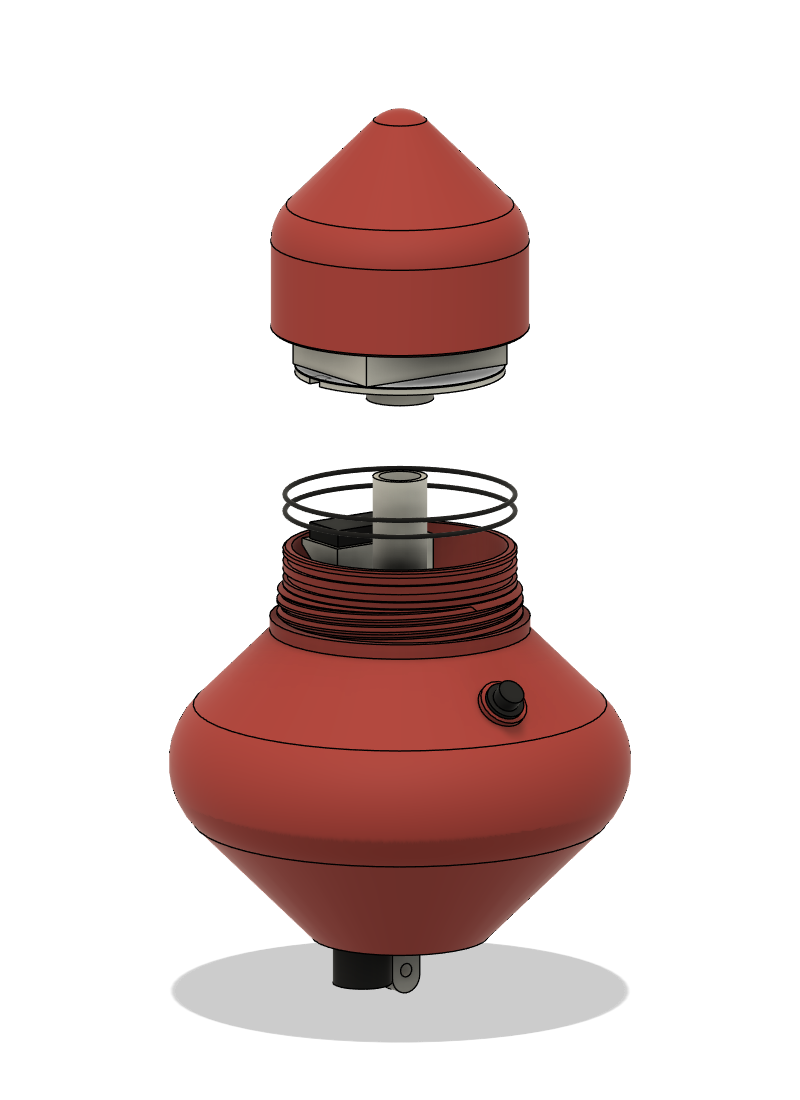
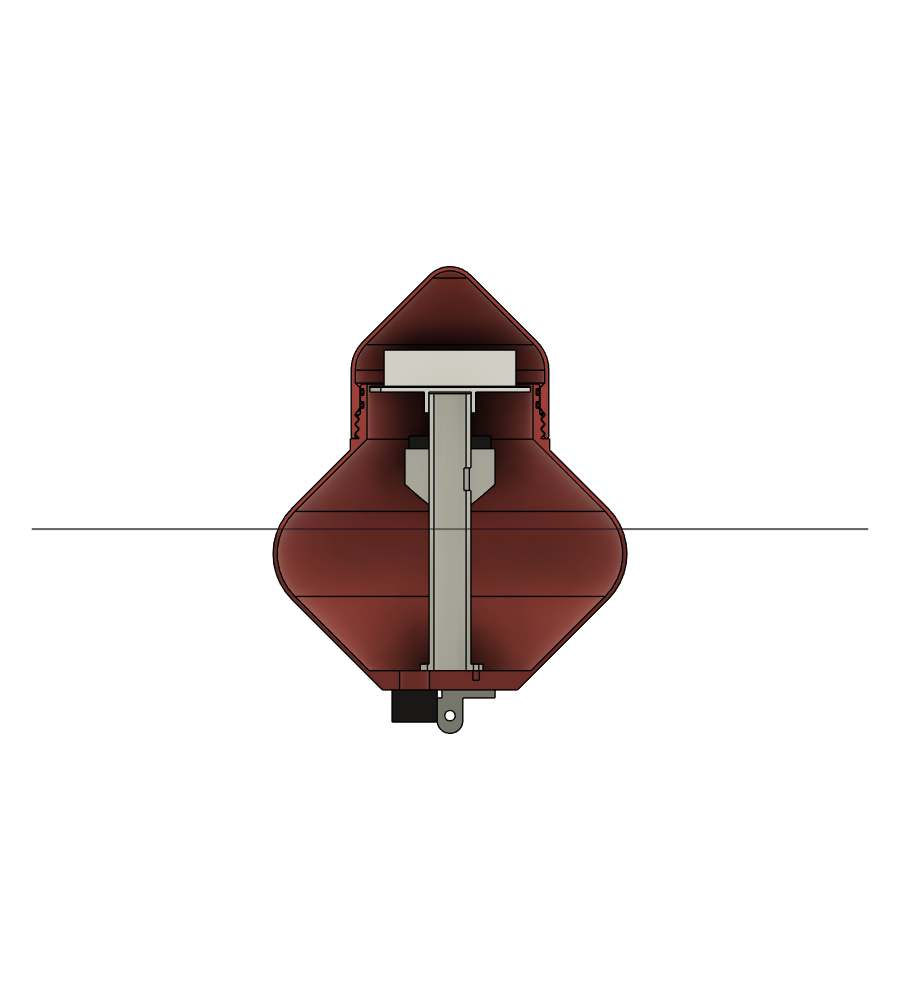
- GNSS antenna Inside the cap's band, on a 100 mm aluminium ground plane on a platform at the top of the mast: about 104 mm above the water.
- Cap and thread The cap screws onto the float in 1⅓ turns on a printed two-start thread, and two O-rings on the float's spigot seal it. The cap carries nothing, so nothing inside turns with it.
- Charge/ON socket On a boss on the float's upper cone, 29 mm above the still water, so the buoy is switched on and charged from a boat; the float's own test valve is on the far side. Inside the float, 220 mm across and 0.97 kg in all, the Feather — the controller and radio — sits on a shelf, 51 mm above the water.
- Still waterline The dashed rule, 14 mm above the float's widest point: 164 mm of float stands above it, with 2.16 kg of buoyancy in reserve.
- Hose gland Where the hose enters the float, in a solid boss under it.
- Eye plate A lug on the float's axis; the cord and the limit line hang from it on a stainless shackle.
- Coiled hose A self-coiling air hose round the cord carries the cables, dry inside. A coiled hose is a spring too, so its ends are lashed to the shackles and it counts as part of the link. It is sealed at both ends, so a cut hose floods only itself.
- Shock cord and limit line The cord and the hose carry the torpedo together, one soft link of about 85 N/m whose cord is cut to length by test. A Dyneema line beside them goes taut only if the link stretches another 310 mm.
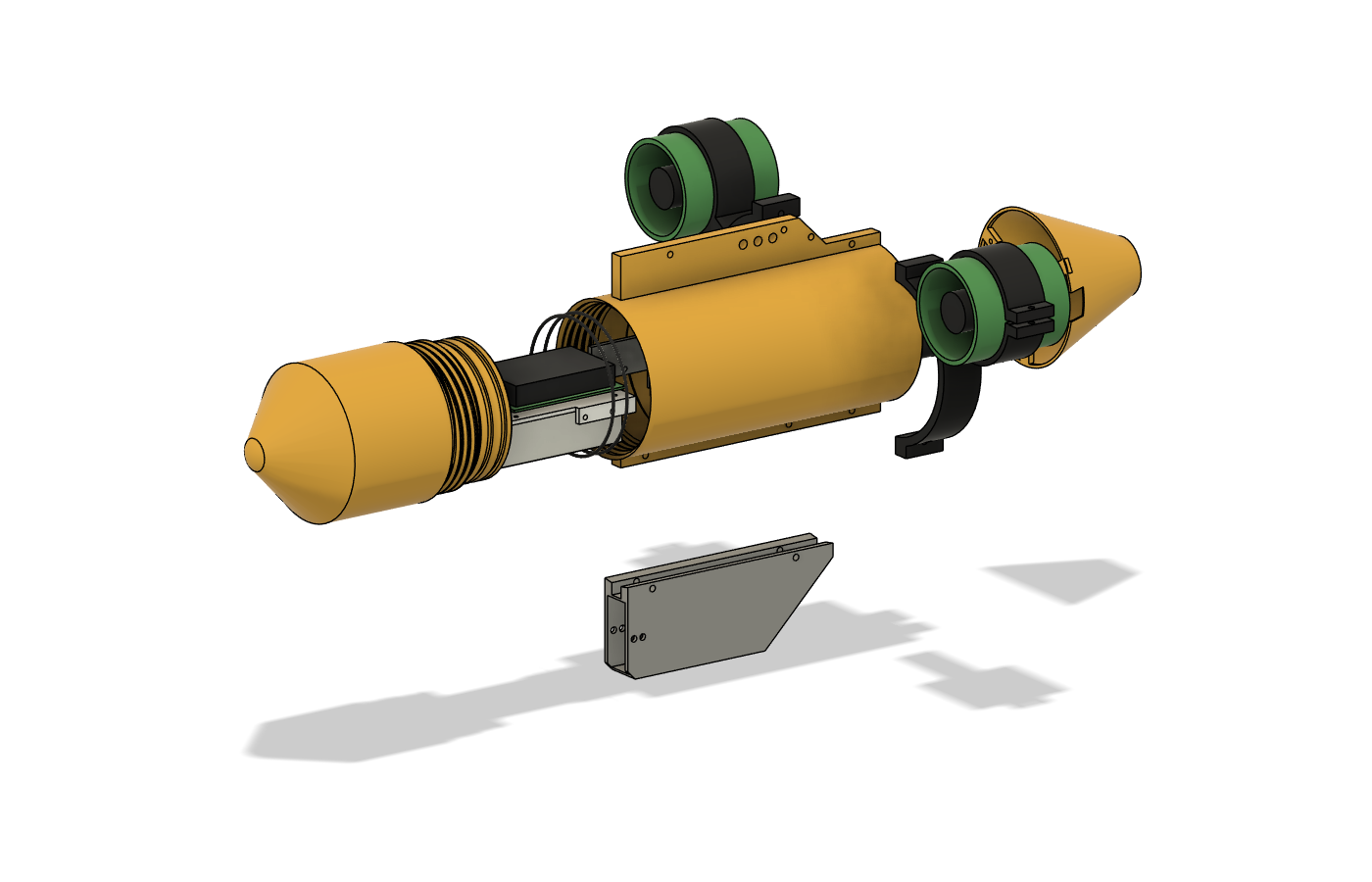
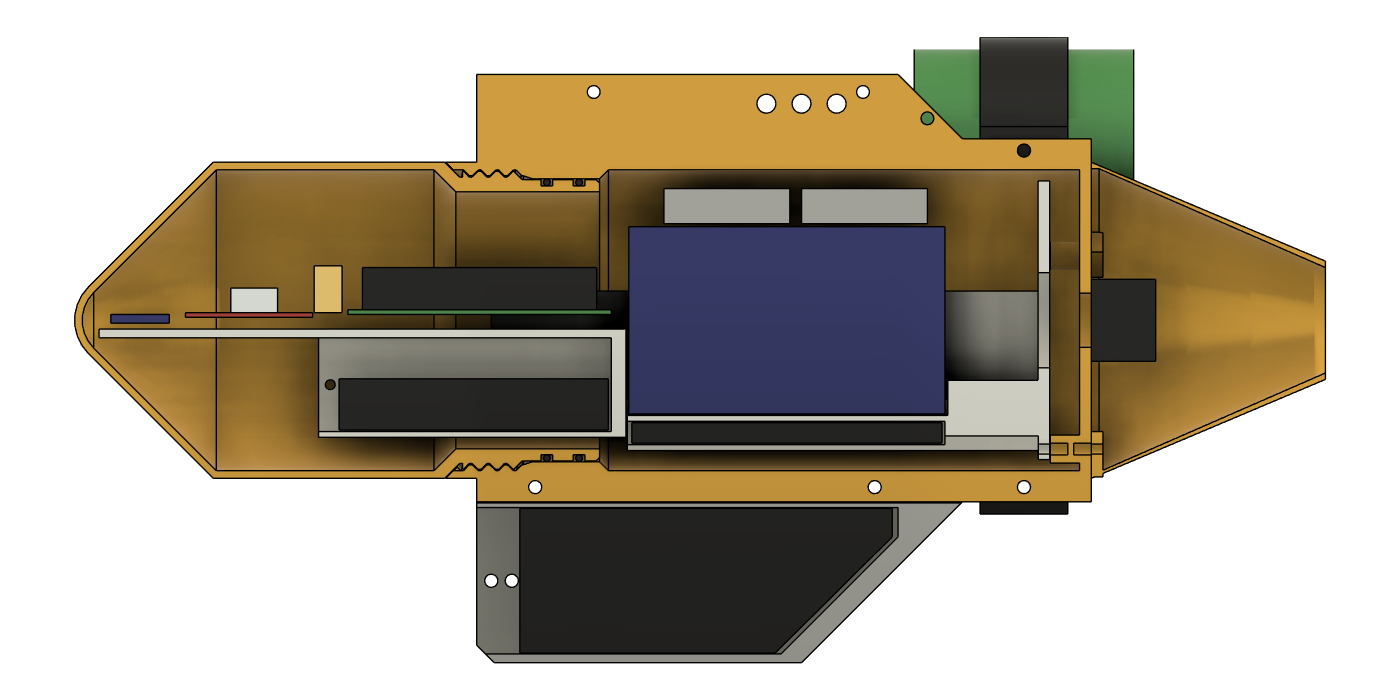
- Nose Screws onto the tail cup in two turns. Under it, on the fore sled: the carrier board, the GPS board and, at the very front, the compass.
- Fin and shackle The bottom shackle goes through one of three holes in the fin. The middle one is over the point where the torpedo's weight acts; the tank trim picks the one that hangs it level.
- Tail cup The canister's back half, with the battery and both motor controllers inside on the aft sled, the glands in its aft face, the fin above and the keel below.
- Thruster pod A stock ducted pod each side, clamped in a printed collar on an arm 58 mm above the canister's axis. There its thrust balances the cord's pull on the fin, so the torpedo stays level when it pushes.
- Tail fairing A free-flooding cone over the glands. The hose comes in through its open tip.
- Keel A printed blade holding about 1.3 kg of lead bars, low down where they do the most for stability.
The whole buoy from the port side, so the bow is on the left. The link is drawn at its resting length: the torpedo's axis is 800 mm below the surface.
A soft line, not a stiff hose
A wake lifts the float in about a second; the deep, heavy torpedo doesn't follow that fast. A stiff link snatches on every wave — several hundred newtons in the simulation — and pulls the float under. The soft link stretches instead.
Three sealed spaces
The float, the hose and the torpedo are sealed separately: the hose is potted shut at both ends, so neither a leak in the float nor a cut hose can reach the battery. Each body has its own test valve.
The nose is only a cover
Both sleds are bolted to the tail cup, so the nose screws on and off around them. Nothing winds up, and the compass stays exactly where it was calibrated.
In a boat wake
The float and the torpedo were simulated in regular waves, joined by a line that can pull but not push. With a stiff link the line goes slack on every crest and snatches on every trough; with the design's soft link it stays taut and gentle. The torpedo itself still moves with the water, heaving up to about a third of a metre in a 0.5 m wake, but the line never snatches and the float stays up.
| Wake | Stiff hose or rope: peak pull | Float dunked by | Soft link: peak pull | Float dunked by |
|---|---|---|---|---|
| 0.2 m, every 1.5 s | 342 N | 233 mm: antenna under | 23 N | 128 mm |
| 0.3 m, every 1.5 s | 383 N | 263 mm: float under | 27 N | 148 mm |
| 0.5 m, every 2 s | 443 N | 303 mm: float under | 31 N | 196 mm |
The numbers
| Float | 220 mm across, 263 mm tall, 0.97 kg; 164 mm out of the water |
| Torpedo | 108 mm across, 427 mm long with its tail fairing, 259 mm across the thrusters |
| Depth | Axis 0.80 m down, keel 0.92 m, and it heaves in wakes: it needs about 1.4 m of water |
| All-up mass | 6.3 kg, 2.6 kg of it lead |
| Weight carried by the float | 1.5 kg: the torpedo's weight in water, set by its lead |
| Link | A rubber cord and a coiled hose side by side, about 85 N/m together, 610 mm at rest; a limit line at 920 mm |
| Under thrust | The torpedo stays within 1° of level; the float heels 1.6° at normal station-keeping thrust and 8.0° at the most one battery can supply |
| Compass from the motors | 302 mm (spar 380, Egg about 170) |
| Endurance | About 2.3 h on one 6 Ah pack, as for the Egg |
| Printing | 13 parts, about 48 hours: 1.46 kg of PETG and 0.21 kg of PLA |
Two bodies, no tools
| Module | What it is | Serviced |
|---|---|---|
| Tail cup | The canister's back half with its glands and valve, the fin and the keel outside, the pods on their mounts, and inside the aft sled carrying the battery, the motor controllers and lead | Stays put |
| Fore sled | Bolted between the aft sled's rails: the carrier board, the GPS board, the compass and more lead | Exposed when the nose is off |
| Nose | A cover with two O-rings and a thread | Unscrews in two turns |
| Float | The body with its fittings, the mast with the Feather and the antenna, and the cap | Cap unscrews in 1⅓ turns |
Printing it
Thirteen parts, each sliced and checked layer by layer: every layer stands on the one below, so supports stay off. Anything that seals, takes the cord's load or sits in the sun is PETG; the dry sleds inside the torpedo and the free-flooding tail fairing are PLA.
| Part | Material | Time | Weight |
|---|---|---|---|
| Float body | PETG | 11.4 h | 425 g |
| Tail cup | PETG | 8.8 h | 343 g |
| Nose | PETG | 5.2 h | 209 g |
| Keel | PETG | 3.2 h | 100 g |
| Float cap | PETG | 3.5 h | 136 g |
| Mast | PETG | 3.3 h | 66 g |
| Aft sled | PLA | 3.4 h | 103 g |
| Fore sled | PLA | 2.5 h | 71 g |
| Pod mount × 2 | PETG | 2.0 h each | 76 g each |
| Tail fairing | PLA | 1.1 h | 35 g |
| Antenna platform | PETG | 0.8 h | 25 g |
| Eye plate | PETG | 0.5 h | 6 g |
Why not all PLA? PLA is the easiest to print, and it is used wherever it is safe. But it creeps under a steady load in water and softens at 55–60 °C, which the inside of a closed float reaches in the sun. The parts that seal, carry the cord or live in the float are PETG, still a standard filament on the same printer.
Reviewing it
The review set out to show the design would work, and it changed the design in places:
| Found | Changed to |
|---|---|
| A stiff hose snatched at over 1 kN in wakes and dunked the float | A rubber cord with a limit line, the hose slack beside it |
| The battery cradle would not fit through the tail cup's opening: its corners stood 2 mm proud of the bore | A floor and two walls joined only clear of the battery's corners, so the loaded sled slides in |
| The front sled hung on a single bolt that broke out of its mounting | Rails reaching into the nose, with two bolts each side |
| One of the cradle's screws sat behind the lead tray, where no screwdriver could reach | A slot along the tray for a long driver |
| The fin's hole for the line was closed at both ends, so nothing could be put through it | A cross hole for a stainless shackle, in the fin and in the float's lug |
| The keel's lead slot was open along its bottom, and held a fifth less lead than assumed | A deeper keel with a floor under the slot, and the lead worked out from the slot's real shape |
| A leak in the float would have drained down the hose into the battery | The hose sealed at the float, and a test valve for each body |
| The float's wall was paper-thin where its thread began | A short straight band under the thread |
| The coiled hose had been treated as slack. A self-coiling hose is a spring: it would have pulled as hard as the cord, in the wrong places | Its ends lashed to the shackles, counted as part of the link, and the cord cut to suit it by test |
| The O-rings would have been screwed across the threads' crests and over a square edge | Threads moved clear of the O-rings, and a lead-in at the bore |
| The bolts joining the two sleds could not be fitted inside the canister | The sleds are bolted together on the bench and go in as one stack |
| Too little trim adjustment, and nothing to keep the front lead in | Three shackle holes, and a keeper bolt on the front lead tray |
| The GPS antenna's plug had nowhere to go, and nothing held the antenna or its ground plate | Room for a right-angle plug; the plate and antenna bonded, their cable through a notch |
Building one
Printing comes first: about 48 hours, the float body and the tail cup the longest at 11 and 9. After that the work is fitting out two sealed bodies and the line between them, with cure times setting the pace, and a tank test to set the lead before the first outing.
- Print the partsThirteen parts, supports off: PETG for anything that seals or carries load, PLA for the sleds and the tail fairing.
- Clean up, tap and fit insertsSand the sealing bores, tap the gland holes, press in the inserts.
- Seal the shellsTwo thin coats of epoxy outside the tail cup, nose and float, never on a bore or a thread.
- Fittings and O-ringsThe charge/ON socket and both test valves, wired and fitted.
- Dry-fit both jointsThe nose and the cap on by hand.
- Pressure testEach empty body pumped up and held under water.
- Pods and their glandsEach pod clamped in its mount; its leads in through a sealed gland.
- The harness in the hoseThe cables and the antenna's own lead, its plug cut off, drawn through the coiled hose.
- Size the linkThe hose's own spring measured, then the shock cord cut so the two together carry the torpedo at the right stretch, and the limit line set.
- Fit the linkThe eye plate under the float, the hose through its glands and lashed to the shackles, the cord and limit line shackled to the float and the fin.
- Build the sled stackOn the bench: the battery and controllers on the aft sled, the boards and compass on the fore sled bolted between its rails, lead in both trays.
- Float fit-outThe mast, the radio and the antenna on its ground plane.
- Bench test before pottingPower, the data bus over the long cable, and the thrusters, before anything is sealed.
- Pot both ends of the hoseSo the float, the hose and the torpedo are three separate sealed spaces.
- The stack into the tail cupSlid in as one piece and screwed down from the front with a long driver.
- Thrust, current and the one-pack ceilingMeasured, and the thrust limit set to suit one battery.
- Close up and pressure test againNose on, both bodies tested.
- Keel and its leadLead bars sealed in epoxy, slid into the keel and held by two keeper bolts, the keel bolted on.
- Tank trimThe torpedo weighed under water: 1.5 kg and level, set with the front lead and the choice of shackle hole.
- Tail fairing and compass calibrationThe fairing over the glands, then the compass calibrated.
- First waterOn a retrieval line, torpedo first, then a strike test before anyone skis near it.
Where it can bite
The open questions, and what is done about each:
| Risk | What is done about it |
|---|---|
| A ski fin catching the line | The main hazard this design leaves. A ski crossing right over the float could hook the line below it, as fins sometimes catch a course ball's anchor line. The line carries the cables, so it cannot simply part, and at ski speed the snag would be stopped by whatever gives first. Nobody skis near it before a snag test in the water; a designed breakaway is a decision still to make |
| A boat running over it | A tow boat's propeller and rudder reach about the torpedo's depth. Use the torpedo for the turn balls, which skiers hit, and the Egg for the boat-guide and gate balls, which boats clip |
| Deeper water | It needs about 1.4 m at the shallowest ball (the torpedo heaves in wakes), against half a metre for the Egg |
| The hose can wind up | The float and torpedo can turn relative to each other. If the torpedo keeps circling one way, the hose twists. The firmware should count turns and unwind; until it does, check the coil after each session |
| A longer cable to the radio | The data bus and the radio's power now run 1.7 m through the hose. Heavier power wires, a capacitor at the radio, twisted signal pairs, and a bench test of the bus with the real cable before it is sealed |
| The radio sits low | About 50 mm above the water and under the antenna's metal plate. Range-test early; the recommended fix is the version of the radio board with an external antenna, mounted higher |
| The compass and tilt | The compass has no tilt correction. The pods keep the torpedo level under thrust, but wakes rock it by several degrees. A tilt-compensating motion sensor is a requirement before heading is trusted in wakes; it needs a firmware change |
| Antenna and thrust in different bodies | The float and the torpedo swing against each other on the soft link, about every 1.7 seconds, the float doing most of the moving. Station-keeping is tuned gentler than on the spar |
| One battery | As for the Egg, the thrust ceiling comes down to suit one pack. A printed extension between nose and tail cup could take a second pack |
| A flooded torpedo | About 1.6 L of water would get in; the float still holds it up, riding low, but the electronics are lost. Epoxy outside, a pressure test of each body after every reassembly, desiccant, and a retrieval line until the buoy has earned trust |
Parts
Beyond the printed parts and the electronics it shares with the spar, the torpedo needs O-rings, cable glands, two test valves, heat-set inserts and stainless fasteners, a coiled air hose, rubber cord and Dyneema line, an aluminium disc, lead bars and epoxy. The itemised list and the print files are kept with the project but are not published here. The build guide walks through printing and assembly.